On 8 March 2022, First Minister Nicola Sturgeon offered a formal apology to those accused of witchcraft in Scotland. Delivered on International Women’s Day, the apology highlighted the “historic injustice” suffered by thousands of people during an unsettled period of Scottish history.
In 1563, the Witchcraft Act made witchcraft a criminal offence in Scotland. Over the next two centuries, more than 4,000 people would be persecuted under this law. First published in 2003 by the University of Edinburgh, the Survey of Scottish Witchcraft aimed to create a database of every recorded accused witch in Scotland. It has been at the forefront of revising our understanding of who the accused were, why accusations were made, and where these individuals lived.
The majority of Scotland’s witch trials and executions took place between 1590 and 1662. Stirling’s largest trial occurred in 1658–1659, just before one of Scotland’s final major witchcraft “panics” in 1661–1662.
Accusations of witchcraft were typically brought before local courts, and within our records we have identified several individuals accused in the local area. Many of these cases appear in the records of the Stirling Presbytery, which was responsible for gathering evidence for trials.
Witchcraft in Stirling before 1590 has received little attention. However, our records contain references to two early cases that illustrate how accusations were handled before the major panics. One of the earliest written references to witchcraft in Stirlingshire appears in the Stirling Burgh Court records.
Royal Burghs were granted authority to administer their own courts, dealing with criminal, civil, and administrative matters within the burgh boundaries. These courts typically handled smaller offences such as theft, assault, and breaches of the peace.
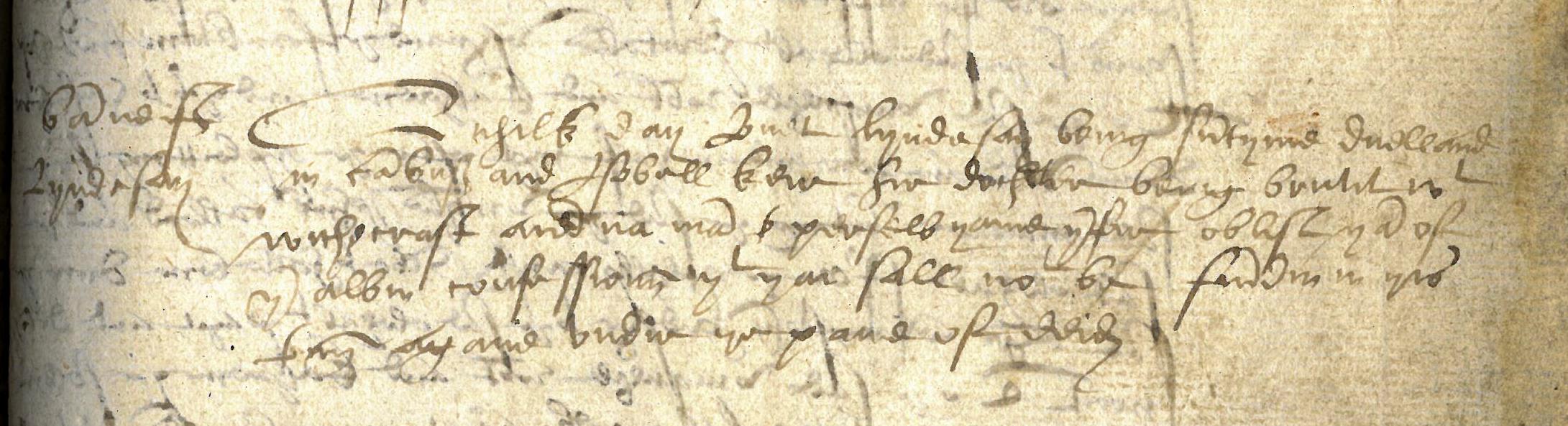
On 1 September 1562, Jonet Lyndsie and her daughter Isobell Keir, who lived in Cambus, were “brutit with witchcraft” before the Court. No evidence survives to show what Jonet or Isobel were accused of doing, but the punishment assigned to them indicates that the matter was taken seriously. They agreed that they “sall nocht be fundin in this toun again, undir the pane of deid.” Although the case is sparse in detail, it highlights a common misconception: not all accused witches were tried and executed. In this instance, banishment was sufficient.
Another early case appears in the Stirling Presbytery records. Local church courts were often the first place an accused witch would appear to justify their actions. On 13 April 1587, Margaret Ritchie was brought before the Presbytery to prove that Marjorie Robertsone had taken milk from her father’s cow through witchcraft. Margaret stated that she was “nocht yet fullie advysit…with hir answer” and requested more time. The Presbytery agreed to reconvene on 15 April to determine whether the accusation was true or slander.
At the next meeting, Margaret refused to “tak upne hand” to prove that Marjorie had taken the milk by witchcraft. After also refusing to affirm her accusation, the brethren concluded that Margaret was a “sclanderer…in calling hir an wiche,” which she could “naywayis preive to be of varetie.” As punishment for her false accusation, Margaret was ordered to ask God and the congregation for forgiveness publicly “in the kirk of Sterling upone Sonday nixt.” She was also instructed to seek Marjorie’s forgiveness and acknowledge her as “na thing to hir bot ane honest women.”
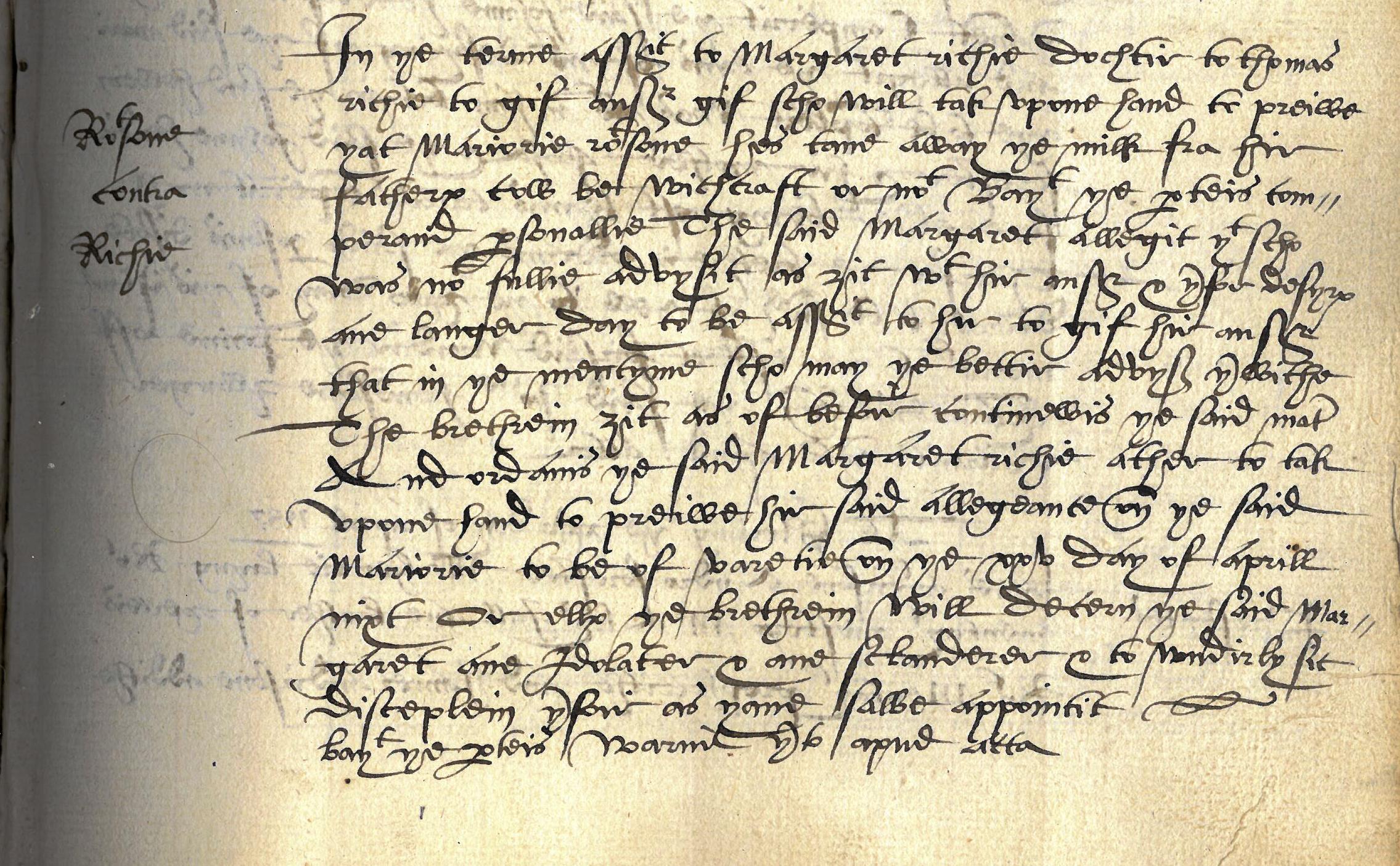
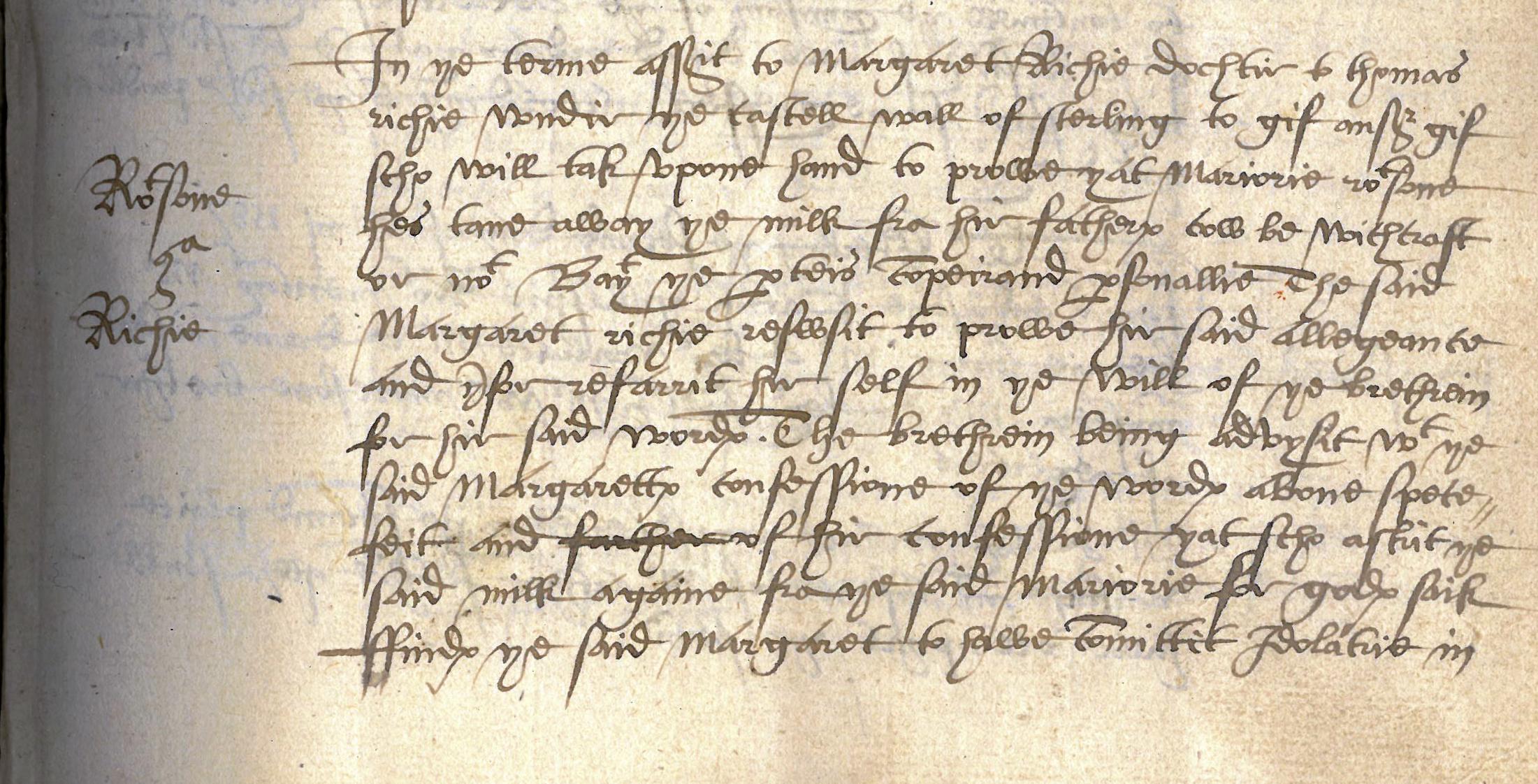
The 1587 case is particularly interesting because it shows how testimony was used to determine whether someone was a witch. It reflects a common neighbourly quarrel, and in this instance the accusation was judged to be false. Had the testimony been believed, however, interrogation could have followed, often with the aim of extracting a confession and establishing a connection to the Devil.
The North Berwick witch trials of 1590 marked the beginning of Scotland’s first major witchcraft “panics.” These two earlier cases, however, offer valuable insight into how accusations were handled before the infamous events of 1590.

