The document of the month for August this year has been written for us by John G. Harrison, noted local historian and frequent user of the Archives. The Archives staff are very grateful to John for this wonderful find, made while he was researching Stirling’s history, and for the fascinating article he has written about it.
The documents are yellowed and dirty with age. The writing is cramped, difficult and fading. These are court records and there is no evidence that anyone has looked into the bundle since it was tied together, around 320 years ago.
Is it just routine court business? A few debts, perhaps? A tenancy agreement? Marriage contracts? Has it been neglected for the obvious reason that it’s just plain boring? Or is there some hidden excitement within? The record of some ancient sorrow? Or the solution of a mystery which has tantalised me for years?
Like other historians, searching through documents in Scotland’s archives, I am usually looking for answers to definite questions, trying to build a picture of the past by piecing together the surviving evidence dispersed in the records. But sometimes the delight of the day is finding something strange and surprising, something quirky and off-beat, something unlooked for and unconnected with the original subject of my research.
And since almost any bundle can contain a surprise, it is always with a sense of excitement and keen anticipation that I untie the tape and start teasing the documents apart and deciphering them.
The particular bundle I have in mind was made up and put away in the early 18th century and involved cases heard before the Stirling Burgh Court in the few years up to 1706. It is now in Stirling Council Archives (SCA reference B66/25/779/1, bundle 5). The bundle includes a dispute about the working of a mill for twisting thread, a claim for payment for some sheep, an argument about a cow, brought to the Fair in 1704 – and lots of citations of witnesses. But one item in the bundle eventually produced a real surprise. It was a bundle within the bundle, several papers folded one inside another, like the layers of an onion. So, the story emerges, bit by bit, not necessarily in the order in which the events took place.
It was an ordinary enough case. Three chapmen or pedlars, William Anderson, James Mitchell and John Bruce, had gone on a drunken spree in Stirling in the October of 1706. It was spread over two or three days. And as they moved from tavern to tavern, they were alleged to have helped themselves to various goodies and some money.
At Isobel Alexander’s house they found there was only a boy in, so they sent him off on a fictitious errand to look for someone at the end of the town. And whilst he was away, somebody slipped into the next room, opened a number of cupboards and chests with false keys and helped himself to what he found within.
This is not without interest. It’s hardly the sort of trick you would be able to work today, in our changed circumstances, where a child would certainly not be left in sole charge of a pub, where even the adult staff do not leave the customers in charge whilst they run messages for them!
The following day the three men spent up to six hours in John Fleetwood’s tavern which was actually run by Fleetwood’s wife; they got mightily drunk, singing songs and shouting and swearing and, it was said, taking some silver buttons, gold coins and other items to a value of £150 Scots, and including three pearls. Even allowing for the fact that a pound Scots was worth only a 12th of £1 sterling, that is an enormous amount and I can’t help wondering if is not exaggerated. The three pearls will play an important role in the emerging story.
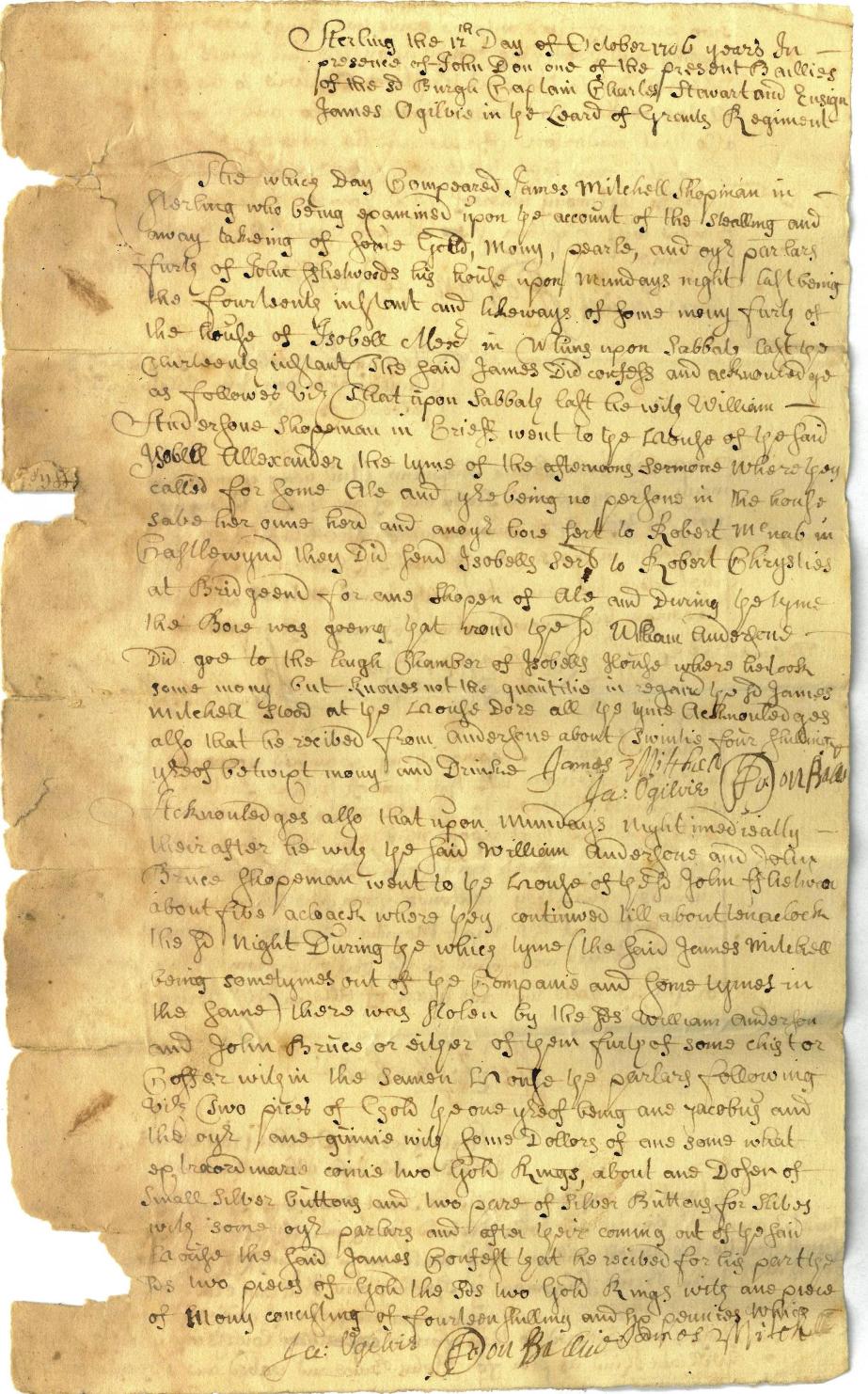
The thefts were soon discovered. William Anderson was picked up the next day. James Mitchell had left town by that time but returned a few days later and was promptly arrested. It is not clear when or how John Bruce was caught. The first paper in the case recounts the story of Mitchell’s examination in the house of Mr John Martin, a lawyer. There he was searched and confronted by John Don, one of the magistrates and by two military officers who were perhaps hoping to force the suspects into signing up in the army to escape prosecution. They had no other reason for being there as it was not a military case.
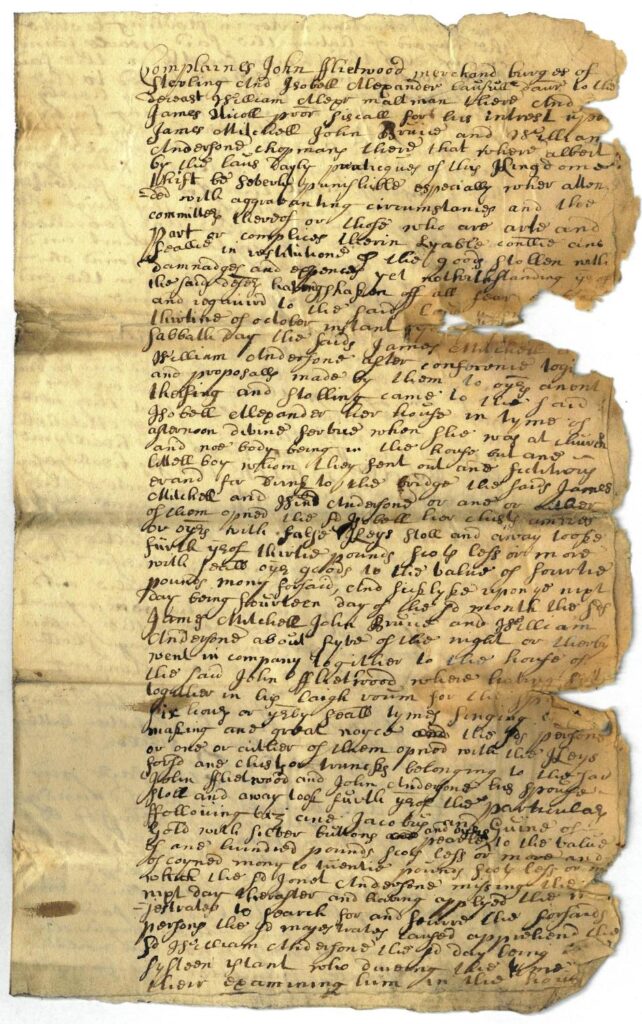
Mitchell’s examination 17th October 1706
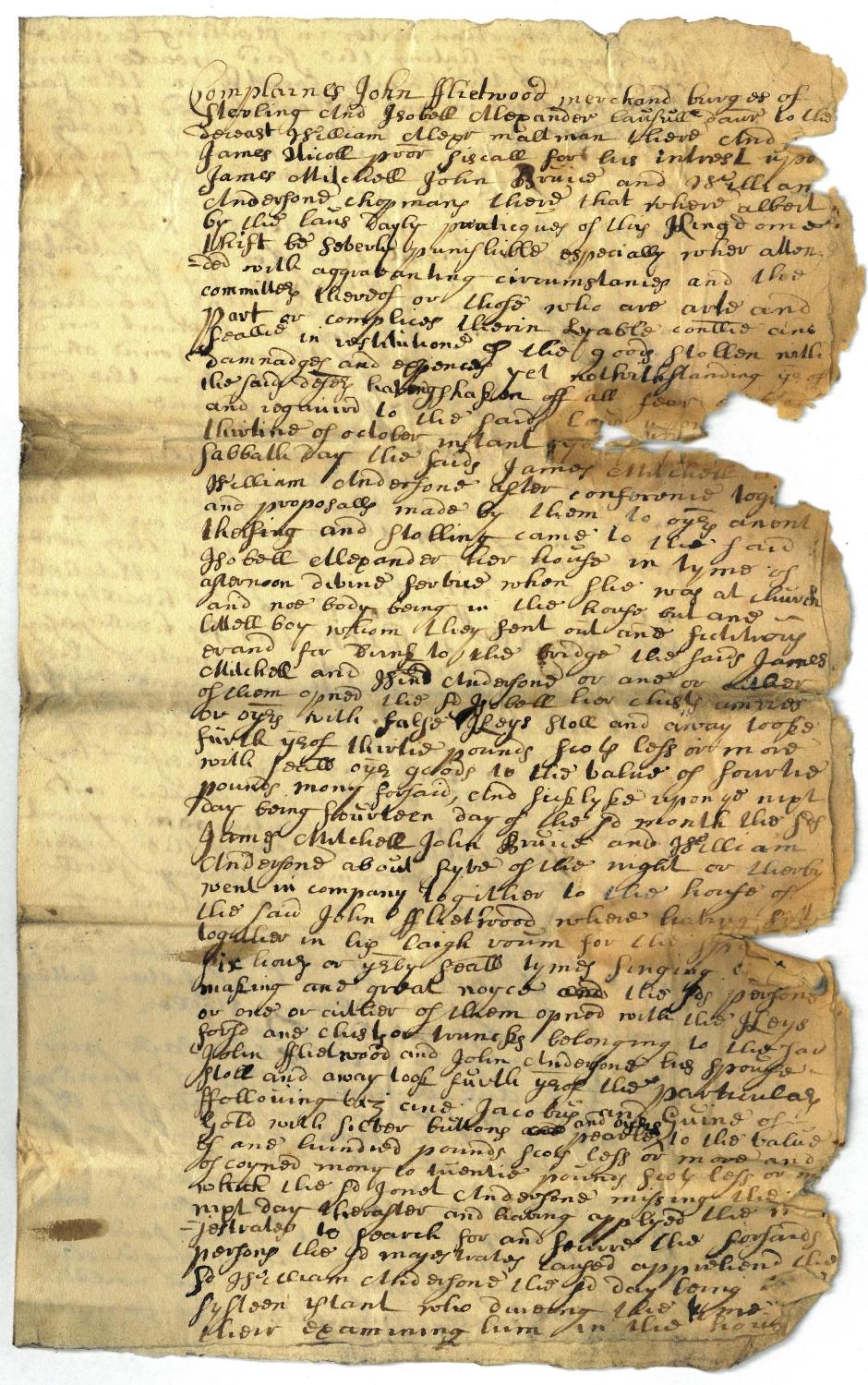
Mitchell was in much deeper trouble than the others as he lived in Stirling and stood to lose his reputation and even his right to live in the town if convicted. His strategy was to confess to a limited role whilst laying most of the blame onto the others. It must have been William Anderson from Crieff who stole the goods from Isabel Alexander’s place, he said. He himself had just stood at the door while Anderson went into the next room.
In John Fleetwood’s house, Mitchell avowed he had been out of the room quite frequently and insisted that it must have been the others who had done it. But he did confess that he knew what had been stolen, and also that he had accepted some coins and two rings from Anderson. These were duly found on him when he was searched. So much, then, for the outer layer of the onion, dated 17th October 1706. The next document was dated 24th October. Evidently the men had spent the intervening week in the Tolbooth whilst enquiries were made and decisions taken. It was a very serious case and could have been prosecuted before the justiciary court. But that would be expensive and time consuming for everyone involved. Also, there was little to gain as most of the goods had been recovered. Many people were surprisingly reluctant to bring serious trouble upon people that they knew, such as Mitchell, the local man.
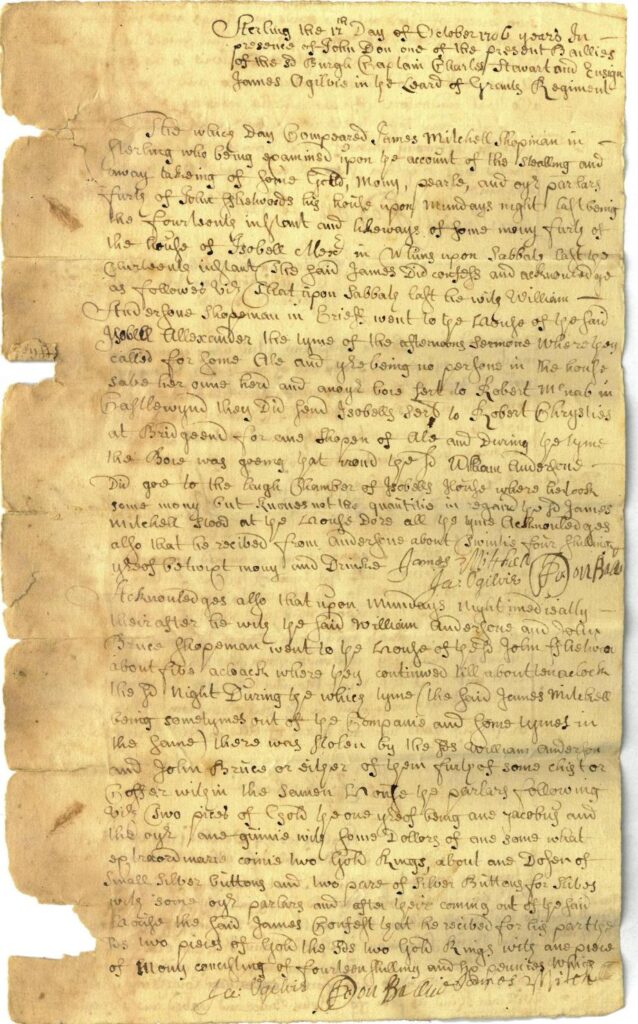
Court proceedings 17th to the 24th October 1706 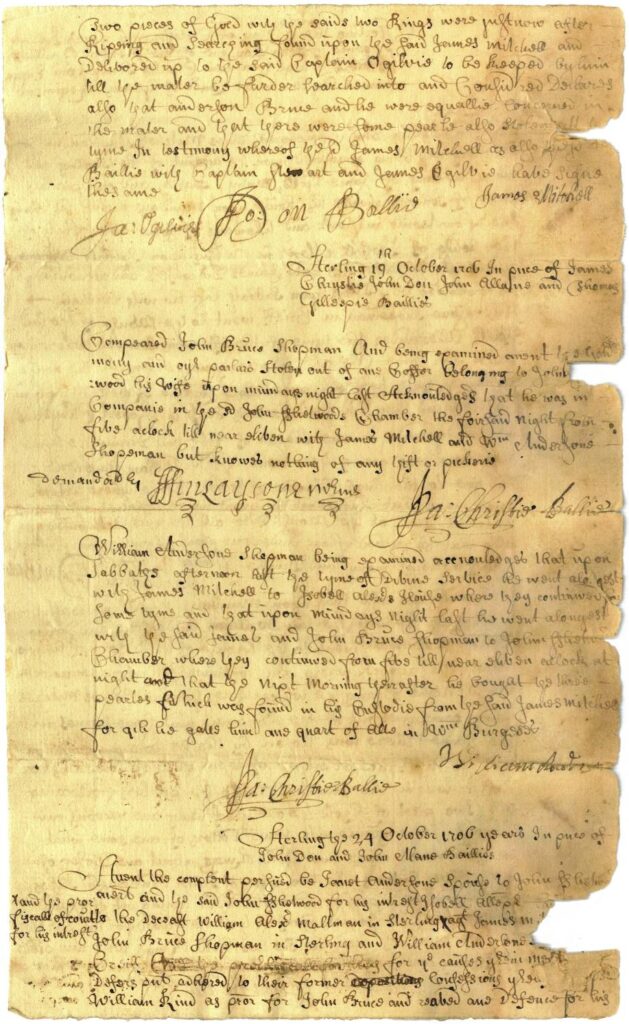
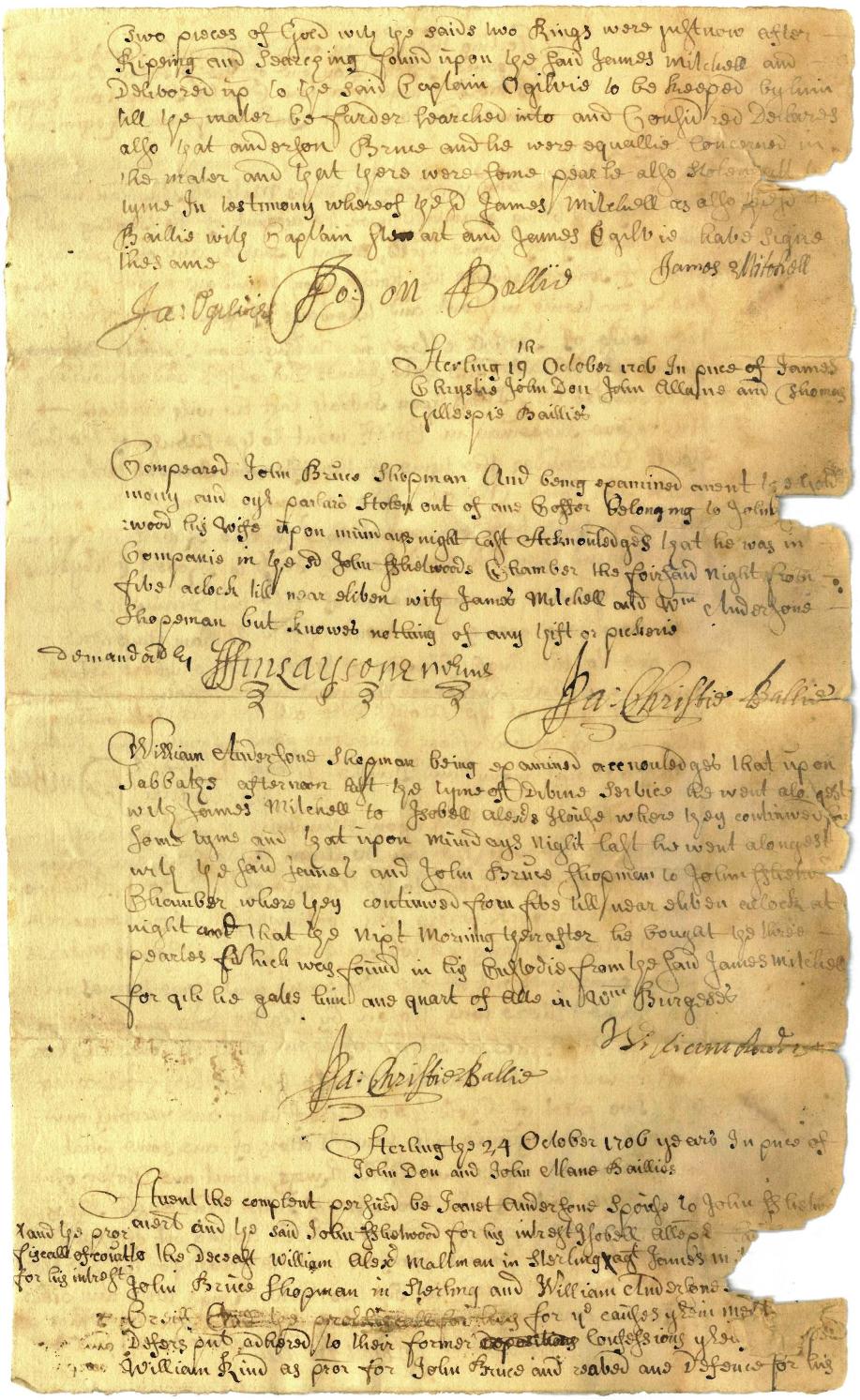
At this second enquiry, Janet Anderson, Fleetwood’s wife gave formal evidence about the value of her losses, noting that she had got her pearls back. Isabel Alexander admitted to some doubts about the precise value of her losses. Meanwhile William Anderson only admitted that he had been with the others and claimed that the next day he had bought the three pearls in his possession when he was caught, from Mitchell.
The third sheet revealed another reason for not taking the case to a higher court: the victims wanted compensation and were more likely to get it if the case was dealt with civilly rather than criminally. But most of this sheet was legal argument by William Rind, John Bruce’s lawyer. Rind said Bruce, who was of previous good reputation, was simply having a good time with friends of his own occupation who, so far as anyone knew when the escapade began, were honest men. He had no reason to suspect them and the fact of being with them was not incriminating in itself, even if they were proved to be criminals. Furthermore, Bruce was so drunk the night they were in Fleetwood’s house that he did not know what was going on. It was well known, Rind argued, that Bruce was susceptible to drink; drunkenness was often held to excuse misdeeds, said the lawyer, even when there was clear evidence of guilt. In this case there was none beyond the fact of his being in company with Mitchell and Anderson in a tavern which was, after all, a public house, open to anyone. Bruce had admitted, and did admit, that he had been drunk, singing and ranting and swearing, and he was very sorry for it and willing to undergo any punishment they might order for that. But as far as the theft was concerned, if they proceeded at all, he would pursue them all for costs and damages.
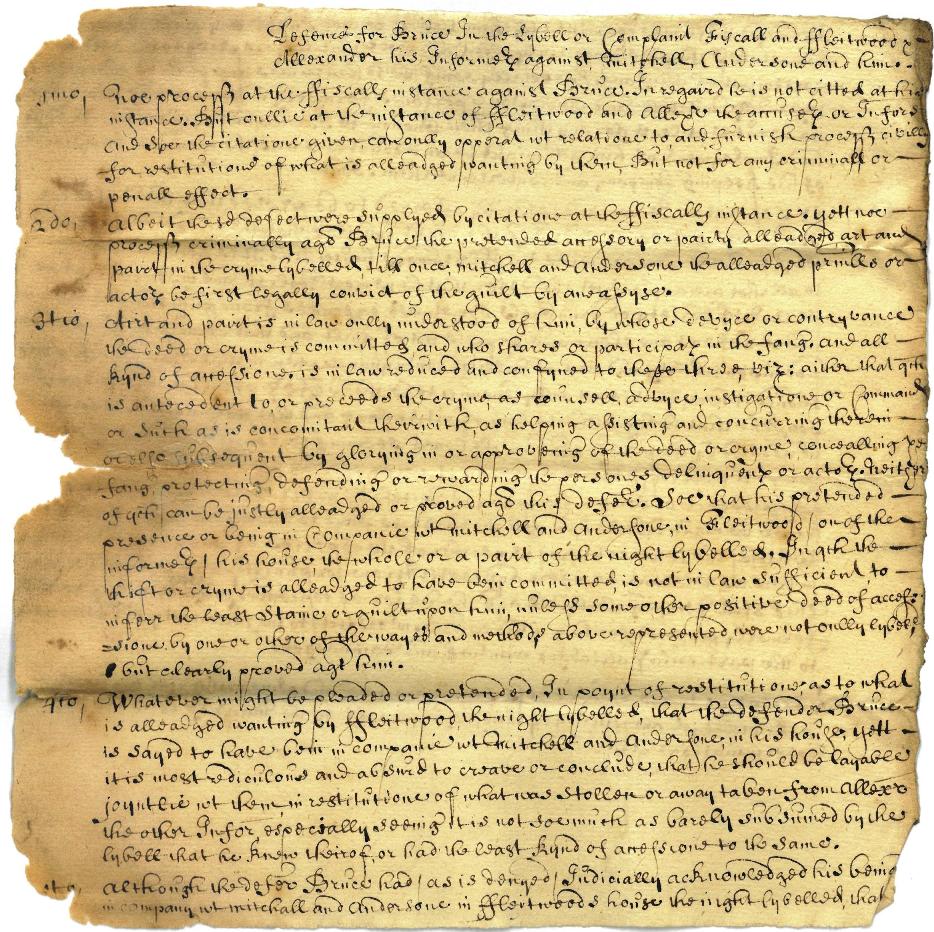
Statement in defence of John Bruce
The Procurator Fiscal (the prosecuting officer) was having nothing of Rind’s legal argument. Bruce had confessed to being present the whole time and it was obvious that he knew about the opening of the chests even if he had not done it himself: he was ‘art and part’ whether he had done the physical act or not. He had not just been present but had connived and had benefited. That was enough to demonstrate guilt.
It was clear by this time that each of the three was trying to blame the others – as many others have tried to do since. One factor that weighed against Anderson and Mitchell was that each had some part of the goods on him when he was caught. In addition, each of them had guiltily tried to disguise his involvement. Mitchell had his share of the haul in a steel box sewn into the end of his cravat. But most intriguingly when he was first taken to John Martin’s house, Anderson secretly dropped something behind his back in the hope that it would not be found on him. But he was not quite careful enough! Investigation showed it to be the three pearls wrapped in a letter from his brother, which, the document says, was ‘herewith, produced’.
As we have seen, the pearls had been returned to their owner at an early stage. Indeed, their owner, Janet Anderson, seems to have dropped any claim against the men, once she had got her goods back. So, my treasure trove was not the pearls. But deep within the bundle, at the very heart of the onion, was a small scrap of paper, a pearl without price indeed- the letter from Anderson’s brother!
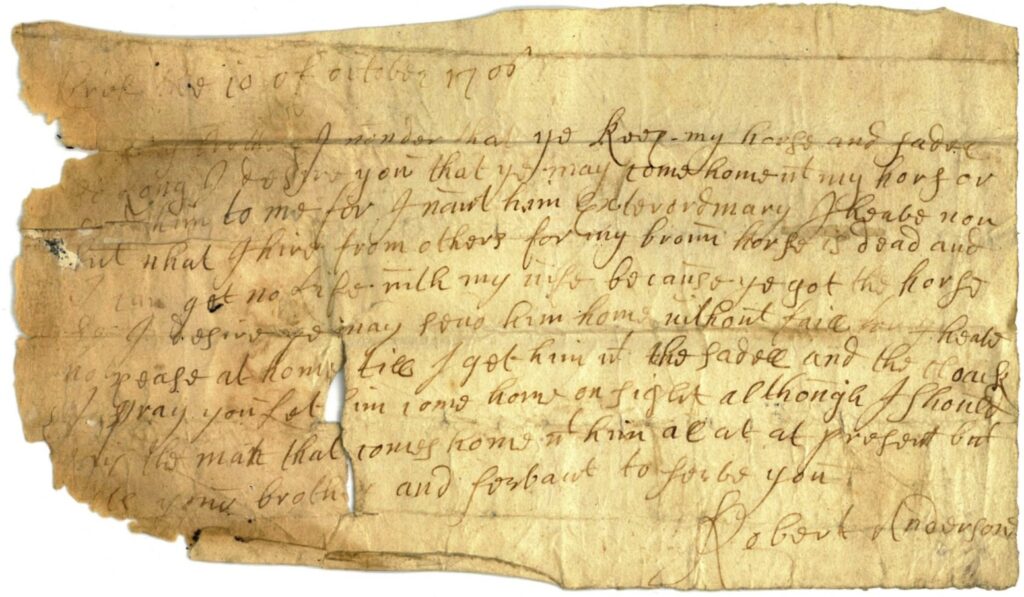
Robert Anderson to William Anderson 10th October 1706
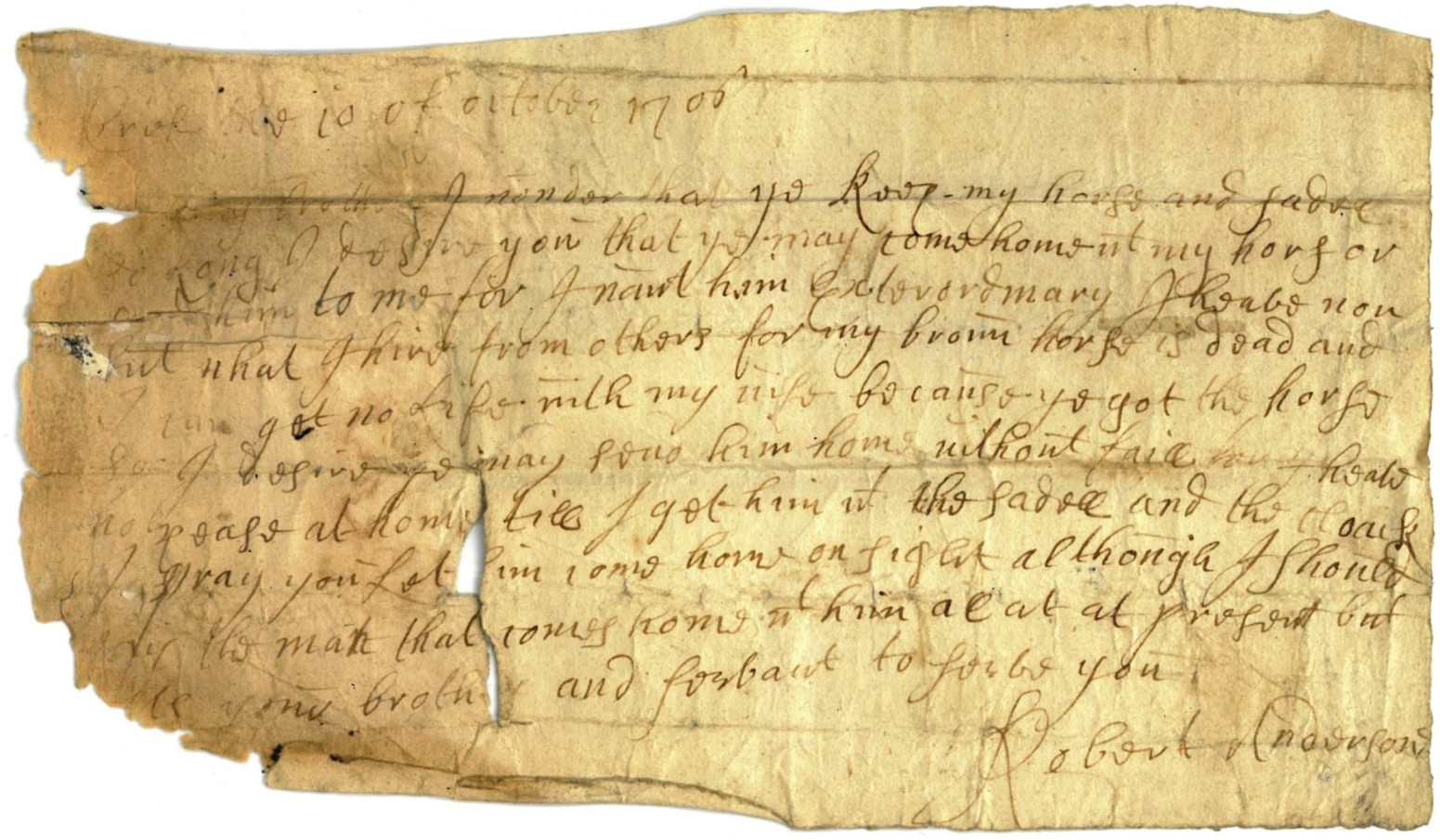
At this time, of course, though literacy was certainly on the increase, most Scots could not write – or could write very little. Some, for example, could sign their names, but only with such difficulty that it is clear they could not manage much else. Nor was it much use to send a letter to someone who could not read. Another problem was to get the letter to its destination. In this case the brother, Robert, had probably given the letter to someone he knew and trusted who was travelling to Crieff, Anderson’s base. But you could not always rely on that sort of thing, and the Postal Service was slow, expensive and unreliable.
So, few Scots, except for officials and the wealthy, either sent or received many letters. And very few, even of those, have managed to survive the intervening 300 years. Most letters are about matters of the moment and are thrown away within a short time. And even the ones which are kept by one generation might be thrown out as old junk by the next. Paper is fragile, vulnerable to damp, mice, insects and fire. Even official records seldom survive intact. Unofficial, informal letters from one ordinary Scot to another are rare indeed.
So, the survival of this letter must be one of the greatest archival freaks on record, the result of a long string of events, from the theft to the discovery and the decision to keep the letter and to use it as evidence in the case. For though it had nothing to do with the litigation itself, it was ‘herewith produced’ that is, it was presented as evidence.
The item in question is 10 by 18cm and has a pretty ragged edge along with much of the bundle it was kept in. It has the name of the recipient on one side (so was not in an envelope) and the message on the other. It does not appear to have been sealed. It is dated from ‘Crok’ (it is not clear where that was) on 10th October 1706 a few days before the theft took place. And it was directed to William Anderson, chapman, to be found at Crieff. It is quite legible but I have slightly modernised the spelling and put in some punctuation. Here is what it says.
Of troth I wonder that you keep my horse and saddle so long. I desire you that you may come home with my horse or send him to me for I want him extraordinary. I have none but what I hire from others. For my brown horse is dead and I can get no life with my wife because ye got the horse. So, I desire you may send him home without fail for I have no peace at home till I get him with the saddle and the cloak. I pray you let him come home on sight [he means on sight of the letter] although I should pay the man that comes home with him. All at present but rests your brother and servant to serve you Robert Anderson.
It is all expressed with complete simplicity and without artifice. He could have been angry, after all the horse was expensive and he must have been wondering if he would ever see it again. Instead, he is quietly desperate stressing the difficulties of the present rather than his fears for the future. Who could resist such feeling? Could William Anderson?
I am afraid the records give us no indication of what happened to the horse. Perhaps Anderson had sent it home before the theft or at least before his capture. After all, we have no indication of how long he had had it or of when its return had been expected. If he did still have it when he was caught, it could have been held as security against the stolen goods. But the letter was surely intended to indicate to the magistrates that Anderson was a shady character, not to be relied upon; Even his brother couldn’t rely on him.
To find the conclusion of the case we must turn from the bundle to the actual court records (SCA reference SBC/37/1/28 p. 39-41); on 26th and 29th of October, over a fortnight after the original theft, during which time the men had been in the Tolbooth prison.
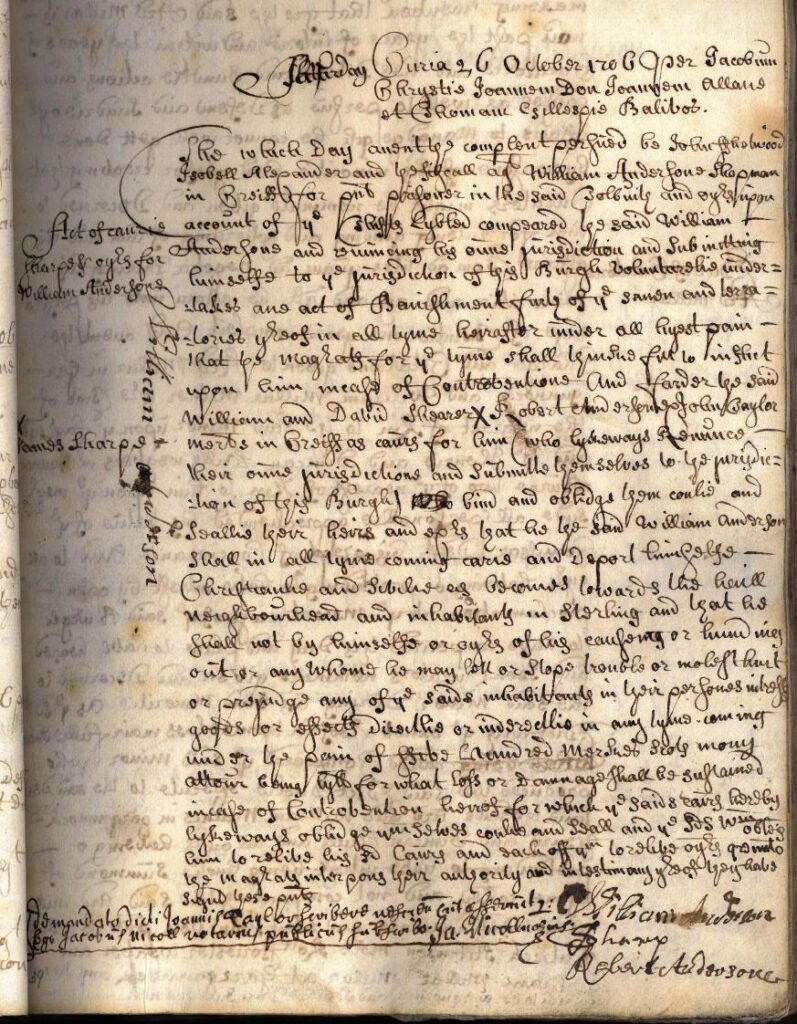
Burgh Court Book 26th October 1706 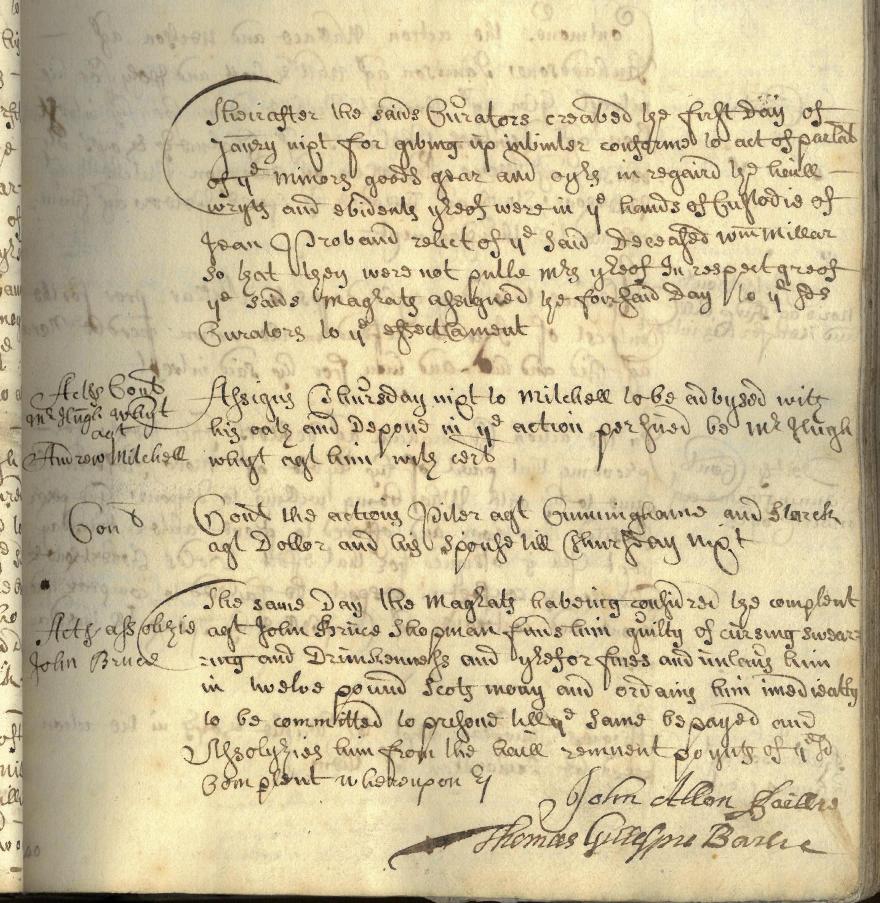
Burgh Court Book 29th October 1706
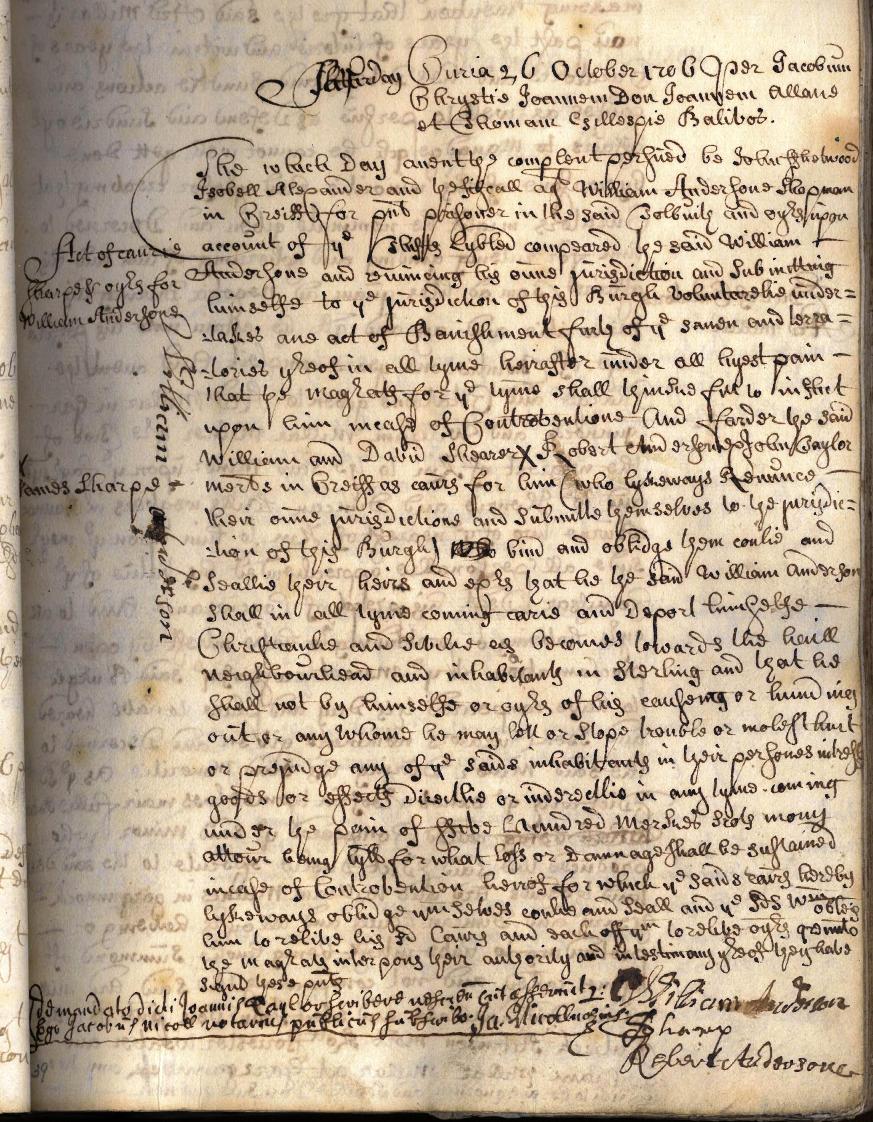
Bruce was lucky. His lawyer’s arguments, perhaps supported by a little gentle string pulling, succeeded, and he was only found guilty of cursing swearing and drunkenness for which he was fined £12 Scots. Mitchell’s fate is unclear but as he continued to do business in Stirling, he must have more or less got away with it too. Anderson’s involvement was clear and he was surely, at the very least guilty of reset of the pearls and other items found on him. Yet he persuaded the magistrates to drop all the charges and to allow him to leave Stirling on condition of never returning, accepting that if he did then he could be severely punished. Incidentally, his security that he would observe the conditions was none other than his long-suffering brother!
I said at the beginning that this was a rather ordinary case. And the letter, too, is rather ordinary. Its writer never thought, for a moment, that anyone but his brother would ever read it. And the notion that I would find it over 300 years later and that you would then read it too would have astonished him out of his wits. But the story of the letter – above all the story of its survival – is extraordinary, unique and exciting. If someone made it up, you would hardly believe them. Yet there it is at the heart of the bundle, with its story intact around it. So, when I start on the next bundle, even though I know that the chances are vanishingly slender, that most records of our history are not used to wrap stolen pearls and do not survive, I always open the bundle with a suppressed sense of anticipation and excitement. You never know what might be inside.

